If your home service business goes silent after 5 PM 25% of Calls Go Unanswered, you’re hemorrhaging revenue every single night. One unanswered evening call can cost up to $1,200, and most businesses are losing six figures annually. Here’s the actual math behind those missed calls.
Key Takeaways
- Between 25% and 40% of inbound home-service calls happen after 5 PM – and most go unanswered, sending customers straight to competitors.
- Each missed call can cost a home service business up to $1,200 in lost revenue, and individual small businesses can lose an estimated $126,000 annually from missed calls alone.
- Responding to a lead within 5 minutes makes a business 100x more likely to make contact compared to waiting just 30 minutes.
- Chatbots can cut average response times from 30+ minutes to under 5 minutes – with real businesses seeing 30% more after-hours leads captured inside 90 days.
- The ROI case for after-hours automation is explored further below, including what the numbers look like after six months at just $50-$500/month.
If the phones go quiet at 5 PM but customer emergencies don’t, that gap is costing real money every single night. Here’s a closer look at exactly how large that gap is – and what it takes to close it.
Grab a Complimentry Growth Plan for Your Business.
Hit the Blue Button and see what’s possible….
The After-Hours Call Crisis Costing You Six Figures
A homeowner’s water heater fails at 7 PM on a Tuesday. They grab their phone, search for a local plumber, and call the first result. It rings out. They don’t leave a voicemail – they scroll down and call the next one. That’s happening to home service businesses across the country every night, and the revenue walking out the door is staggering.
For an individual small business, missed calls can translate to as much as $140,000 in lost annual revenue from after-hours leads alone. The problem isn’t a staffing issue or a quality issue – it’s a timing issue. And timing is exactly what automation is built to fix.
Teams at Business Loud’s AI marketing division have documented this pattern repeatedly across home service clients: the businesses bleeding the most revenue aren’t the ones doing bad work – they’re the ones going dark after 5 PM.
Why Missed Calls Cost More Than You Think
85% of Unanswered Callers Never Call Back
The damage from a missed call doesn’t end when the phone stops ringing. Research shows that approximately 80-86% of callers who reach voicemail on a home-service line hang up without leaving a message. Of those who do leave one, only a fraction ever convert to a booked job. A separate industry figure puts customer abandonment even higher – with roughly 85% of unanswered callers never attempting a second call to the same business.
That means one unanswered call isn’t a minor inconvenience. It’s almost certainly a permanent loss.
Each Missed Call: Up to $1,200 Gone
The per-call math is brutal. Industry estimates place the cost of a single missed call to a small home service business between $100 and $1,200 – with high-ticket trades like HVAC, electrical, and plumbing landing at the higher end. Factor in the cost-per-lead already paid through advertising ($50-$200 per lead in this industry), and a missed call isn’t just lost revenue – it’s a double loss. Marketing dollars were spent to generate that lead, and then it was handed directly to a competitor.
The After-Hours Window Is Your Biggest Revenue Leak
25-40% of Calls Happen Outside Business Hours
Between 25% and 40% of all inbound home-service calls occur outside of normal 8 AM-5 PM business hours, with evenings (5 PM-10 PM) and Saturday mornings representing the heaviest after-hours traffic. That’s not a fringe slice of the customer base – it could be nearly half the daily call volume going completely unaddressed.
During peak seasons – a brutal summer heat wave or a January cold snap – that window can grow even wider, with after-hours call surges pushing into the 40-50% range.
Evening Emergencies Can’t Wait Until Morning
A burst pipe, a failed furnace, a tripped electrical panel – these aren’t problems homeowners schedule around. They need help now. When a business isn’t reachable, the customer doesn’t wait patiently until 9 AM. They find someone who picks up. The first provider to respond to an emergency inquiry almost always wins the job, regardless of reviews, price, or brand familiarity.
Speed to Lead Is the Whole Game
100x More Likely to Connect Within 5 Minutes
The research on lead response time is unambiguous: responding to a new lead within 5 minutes makes a business 100 times more likely to make contact and 21 times more likely to qualify the lead compared to waiting just 30 minutes. Yet the average home service business takes between 29 and 47 hours to respond to inbound leads. That’s not a slight disadvantage – it’s essentially forfeiting the job before it’s even quoted.
Speed isn’t just a courtesy. In home services, it’s the single biggest predictor of whether a lead converts or disappears.
How Chatbots Plug the After-Hours Gap
From 30-Minute Response to Under 5 Minutes
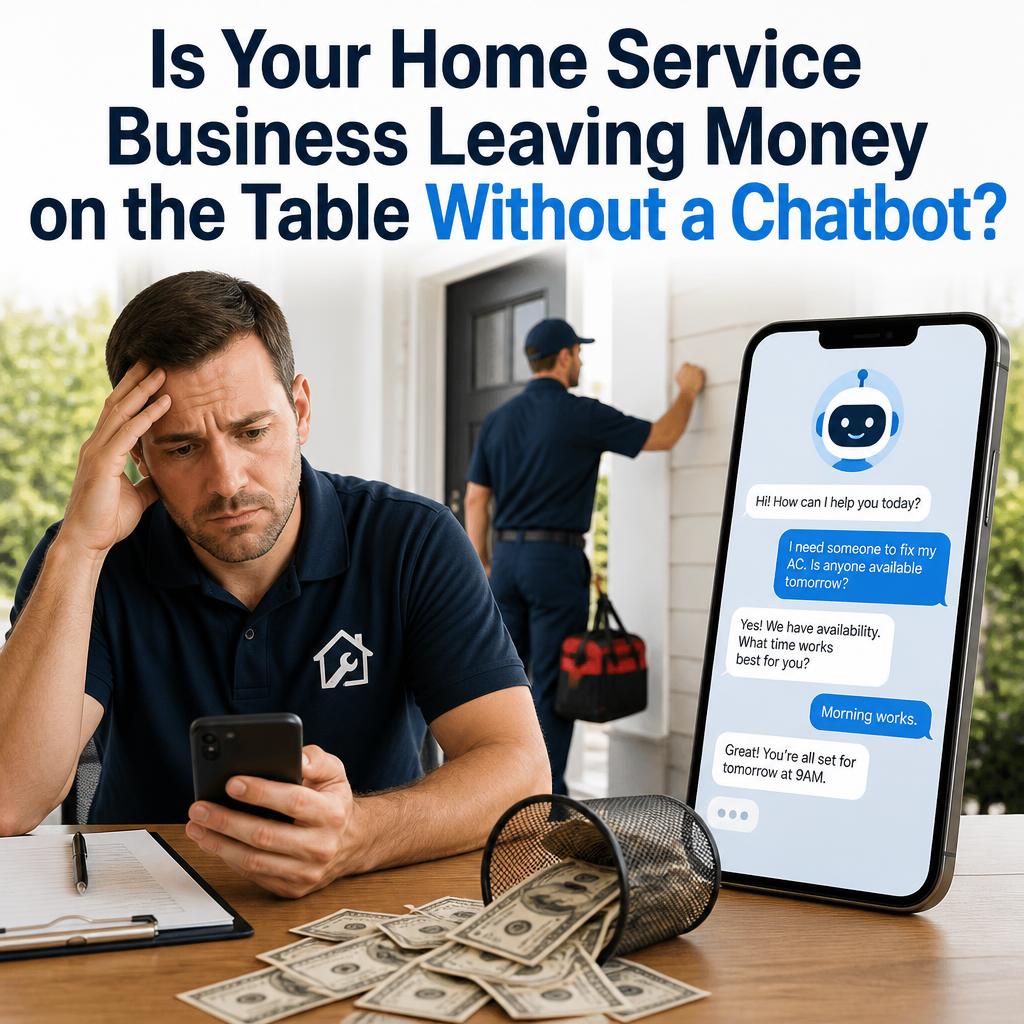
The core value of an after-hours chatbot is simple: it answers immediately. When a homeowner lands on a website at 8:45 PM with a heating emergency, a well-configured chatbot engages them in seconds – not the next morning. Businesses that have deployed automated chat tools consistently report average lead response times dropping from 30 minutes to under 5 minutes, a shift that directly and measurably improves conversion rates.
Instant Intake: FAQs, Booking, and Emergency Routing
A properly built chatbot handles the full intake workflow without human involvement:
- FAQ handling: Instantly answers the most common questions about pricing, service areas, and availability – the questions that eat up hours of staff time each week.
- Appointment booking: Allows customers to schedule service calls directly through the chat interface, syncing with tools like ServiceTitan so nothing falls through the cracks.
- Emergency routing: Identifies urgent issues – a burst pipe, a failed furnace – and escalates them to an on-call technician via a dedicated logic path.
- Lead qualification: Collects the essential details (address, service type, urgency level) before a human ever enters the conversation.
For a three-person office managing 50-70 calls a day, that feature set is the difference between capturing leads and losing them.
The Numbers After 90 Days
Performance data from the first 90 days of chatbot implementation tells a consistent story across the home service industry. Here’s what businesses typically see:
30% More After-Hours Leads Captured
By being present at the moment a customer reaches out – regardless of the hour – businesses recover leads that previously vanished into unanswered voicemails. A 30% increase in after-hours lead capture is a documented outcome for companies that deploy a properly configured automated system.
Conversion Rates Can Improve 23-35% on Average
Faster response times directly translate to higher close rates. When chatbots cut response time from 30 minutes to under 5, lead conversion rates climb accordingly – often improving by 23-35% in the months following implementation. The primary driver is speed and availability: leads that previously went cold overnight are now engaged and qualified before the office opens.
Customer Satisfaction Scores Rise Significantly
Speed benefits reputation as well as revenue. Customers who receive an immediate response, even from an automated system, consistently report higher satisfaction. Post-implementation satisfaction scores have risen substantially in documented cases, with businesses reporting fewer angry voicemails, fewer phone-tag complaints in reviews, and a schedule that’s already half-full before the office opens.
ROI in 6 Months on $50-$500/Month
The financial case is straightforward. Off-the-shelf chatbot platforms – including options like ManyChat, Tidio, and Intercom, which offer home-service-specific templates – typically run $50-$500 per month. The average first-year ROI on a business AI chatbot is approximately 340%, with payback periods as short as three months.
For most home service businesses, recovering just two or three missed leads per month covers the entire cost of the tool. At an average job value of $300-$1,200, that’s a bar most operations clear in the first week of deployment. The recommended approach: start narrow. Script the chatbot to handle the three most common needs – pricing questions, service area verification, and direct calendar booking – then layer in emergency routing and CRM integration once the system is stable. A chatbot treated as a living part of the sales team, reviewed weekly and updated based on real customer interactions, consistently outperforms a set-it-and-forget-it deployment.
Every Unanswered Call Is Now a Competitor’s Win – Fix It Today
The after-hours call problem isn’t going away on its own. Consumer expectations for instant responses keep rising, and competitors who automate their intake will keep answering while everyone else lets it ring. Every evening a home service business goes dark without an automated fallback, the revenue leak continues – and the customers lost to faster-moving competitors rarely come back.
The barrier to entry has never been lower. No-code platforms, home-service templates, and sub-$200/month price points have made after-hours automation accessible to any operation, regardless of size or technical capability. The only remaining question is how long it’s worth waiting while the leads go elsewhere.
Start by auditing the current contact process – measure how long it takes to respond to an after-hours web inquiry, count how many calls go unanswered after 5 PM, and calculate what those missed calls cost at even the low end of $100 per lead. The number is usually enough to make the next step obvious.
Visit BusinessLoud.com to see how their data-driven AI marketing strategies help home service businesses stop losing after-hours leads and start converting them.