
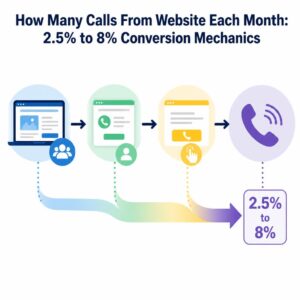
How Many Calls From Website Each Month should your website generate? For many home service businesses, a 2.5% to 8% conversion rate can turn website visitors into valuable phone enquiries—but the outcome depends on traffic quality, service demand, trust signals, page experience, and how quickly calls are answered. Understanding these conversion mechanics helps you set realistic goals and identify opportunities to generate more qualified leads.
Key Takeaways
- A 2.5% website conversion rate sits at the lower end of reported industry averages – local service businesses like electricians can realistically reach 8% with the right optimizations.
- Mobile users drive the overwhelming majority of electrical service searches, making click-to-call buttons and fast load times non-negotiable.
- Local SEO – especially a fully optimized Google Business Profile – is one of the highest-ROI moves a trade business can make for free.
- Responding to a web inquiry within 5 minutes can increase conversion rates by as much as 21 times compared to a 30-minute response.
- The sections below break down exactly how one electrical contractor went from 15 calls a month to 75 – and what any local service business can replicate.
Most electricians with a website assume the site is “doing its job” as long as the phone rings occasionally. There is a significant difference, however, between a site that technically exists and one that actively converts visitors into booked jobs. The mechanics behind moving from a 2.5% to an 8% conversion rate are not complicated – but they are specific, and most local contractors are missing several of them at once.
Grab a Complimentry Growth Plan for Your Business.
Hit the Blue Button and see what’s possible….
Why 15 Calls a Month Leaves Revenue on the Table
Fifteen calls a month keeps a one-person shop barely afloat. For any electrical business with a crew, recurring overhead, and growth ambitions, that number represents a ceiling – not a baseline. The frustrating part is that demand almost always exists in the local market. The gap is not customers; it is capture.
Consider what 15 calls actually means mathematically. A site getting 600 monthly visitors at a 2.5% conversion rate produces 15 calls. Nudge the conversion rate to 8% without changing traffic at all, and that same 600 visitors produces 48 calls. Double the traffic through better local SEO and the number climbs to nearly 100. The revenue difference between those scenarios is enormous – driven entirely by what happens on the site after a visitor arrives.
2.5% Conversion Is a Floor, Not a Target
Reported average website conversion rates vary widely by industry and source, with some studies citing medians as low as 2.35% and others reporting averages above 3%. For home services specifically – where urgency is high and user intent is clear – a well-optimized site should hit 10% to 15% on targeted landing pages. Starting at 2.5% means a business is performing near the floor, not competing near the ceiling.
Two specific problems explain why most electrician websites stay stuck at average.
The Mobile Bounce Problem
When a homeowner smells burning wires or loses power to half the house, they grab their phone. They need a number, fast. Mobile page speed has a direct and measurable impact on bounce rates: slower load times cause sharp increases in visitor abandonment, and even a few extra seconds can cost a business the majority of its mobile traffic. A 70% mobile bounce rate – like the one Sparky’s Electric carried before their overhaul – means seven out of ten mobile visitors left before seeing anything useful.
The fix goes beyond cosmetics. Removing heavy image files, eliminating render-blocking scripts, and building the entire experience around a small screen first are the core requirements. Speed is a conversion tool.
Hidden Phone Numbers Kill Leads Instantly
Eighty-eight percent of consumers who search for a local business on mobile call or visit within 24 hours. That intent disappears the moment they have to search for a phone number. Burying contact info in a footer – or using a non-clickable number – is the equivalent of a storefront with a locked door and no sign. A prominently placed click-to-call button, visible above the fold on every page, is the single highest-impact change most electrician websites can make today.
The Local SEO Gap Most Electricians Miss
A well-built website with poor local SEO is still an invisible website. Forty-six percent of all Google searches have local intent – people looking for services near them, right now. Electricians who are not actively targeting that traffic are leaving the majority of their addressable market behind.
Closing this gap is where teams like Business Loud’s digital marketing practice focus their work – helping local service businesses show up where high-intent customers are already searching.
Google Business Profile as a Call Source
The Google Business Profile (GBP) is arguably the most underused free tool in local marketing. Businesses with complete profiles are 2.7 times more likely to be considered reputable than those with incomplete listings. A fully optimized GBP also places a business in the “Map Pack” – the three local results that appear above organic listings, where a significant share of phone calls originate.
Optimization here means more than entering a business name and address. Updated service categories, recent project photos, accurate service area boundaries, and a consistent stream of customer reviews are all required. Sparky’s Electric generated 30% of their new calls directly from their GBP after optimization – without any additional ad spend.
Neighborhood Keywords vs. Generic Terms
Ranking for “electrician” is nearly impossible for a small local business competing against regional and national players. Ranking for “panel upgrade in [Neighborhood Name]” or “emergency electrician near [City]” is entirely achievable – and those searches come from people who are ready to book, not browse.
Creating five to ten service-specific landing pages built around granular, location-based terms does two things: it improves search visibility and pre-qualifies the visitor before they even click. Someone who lands on a page titled “EV Charger Installation in [City]” already knows what they want. The conversion rate on that page will be dramatically higher than on a generic homepage.
The Blueprint Behind a 400% Call Surge
Sparky’s Electric moved from 15 to 75 calls per month in six months – a 400% increase driven by a structured overhaul, not a single fix. The blueprint had two non-negotiable pillars.
Mobile-First Design as a Non-Negotiable
Ninety percent of the new calls Sparky’s Electric received after their redesign came from mobile users. Every design decision reflected that reality: thumb-friendly buttons, minimal navigation, and load times optimized for cellular connections. The click-to-call button appeared on every page, above the fold, without scrolling required. That single structural change eliminated the most common point of lead loss.
Emergency Landing Pages That Convert
Not all electrical jobs carry the same urgency, and the website should reflect that. A dedicated landing page for emergency services operates differently than a page describing panel upgrade packages. Emergency pages strip away everything that is not the problem, the solution, and the phone number – no gallery, no lengthy company history. Just: here is what is happening, here is how to fix it, here is how to call right now.
These pages also target the highest-intent keywords – “electrician near me open now,” “emergency electrical repair [City]” – which means the traffic arriving is already primed to convert. Higher intent plus reduced friction produces a conversion rate that pulls well above the 8% benchmark.
Tracking Calls Reveals What Actually Works
One of the most consistent mistakes local service businesses make is running marketing without knowing what is generating results. Call tracking software assigns unique phone numbers to different traffic sources – a Google ad, an organic landing page, a GBP listing – so every call is attributed to the specific touchpoint that produced it.
This is not a luxury for large businesses. Once Sparky’s Electric integrated call tracking into their new site, they could see exactly which of their five new landing pages drove the most inquiries. The underperformers got revised. The top performers got more traffic. That feedback loop sustains conversion rate gains over time rather than producing a one-time bump.
Before vs. After: The Numbers That Matter
The results of Sparky’s Electric’s six-month overhaul were measurable across every key metric:
Metric Before After Monthly Call Volume 15 75 Website Conversion Rate 2.5% 8% Cost Per Lead (CPL) $45 $20 Mobile Lead Share Untracked 90%
From $45 to $20 Cost Per Lead
Cutting cost per lead in half changes what is possible operationally. At $45 per lead, a business needs to close a high percentage of calls just to break even on marketing. At $20, there is room to scale traffic, test new channels, and absorb lower-margin jobs without hurting profitability. The reduction happened because the new site attracted direct, exclusive inquiries rather than recycled leads purchased from aggregators that sell the same contact to multiple contractors.
Why Mobile Searchers Drive the Majority of Calls
The 90% mobile lead share reflects the broader reality of how homeowners find emergency services. Research consistently shows that local mobile searches lead to action within hours – often within the same day. A website that is not fully optimized for mobile actively loses the majority of its potential call volume every single day.
The 5-Minute Response Window Changes Everything
Converting a web visitor into a caller is only half the equation. Responding to a lead within 5 minutes increases conversion by 21 times compared to a 30-minute response window. For electrical emergencies, that gap is even more pronounced – a homeowner who does not get a quick response simply calls the next listing.
Internal notification systems – SMS alerts for new form submissions, auto-responder emails confirming receipt, or live chat for after-hours inquiries – close this gap without requiring additional staff. Businesses that fix this step often see a measurable boost in booked jobs without spending a dollar more on marketing.
Fix Your Site Today, Book Better Jobs Tomorrow
The path from 15 calls a month to 75 is built from removing friction, showing up in local search, and making it effortless for a stressed homeowner to reach a professional in seconds. The starting point is a mobile audit: open the site on a smartphone, check whether the phone number is visible and clickable at the top of the page, and time how long it takes to load. Those two checks alone will reveal whether the site is built for the customer or just for the business owner’s peace of mind.
From there, the priorities are clear: claim and fully optimize the Google Business Profile, create service-specific landing pages targeting neighborhood-level keywords, integrate call tracking, and build a response protocol that gets back to every inquiry within five minutes. None of these steps require a massive budget – they require intention and execution.
For local service businesses looking to build on these strategies with expert guidance, Business Loud specializes in digital marketing built specifically for trade and home service companies.
Company: Business Loud https://businessloud.com