Most small businesses lose 8-12 hours each week on marketing tasks that don’t connect or convert. Disconnected tools create gaps, and without a cohesive system, you’re not just wasting time—you could be missing up to 50% more qualified leads.
Key Takeaways
- A complete Done-For-You (DFY) marketing system can handle the entire lead lifecycle – attracting prospects, nurturing their interest, and converting them into paying customers – as one connected process.
- Small businesses lose an estimated 8-12 hours per week to fragmented, manual marketing tasks that a unified system can automate.
- Companies that excel at lead nurturing generate 50% more sales-ready leads at 33% lower cost – a gap that disconnected tools rarely close on their own.
- AI-enhanced DFY systems improve over time by learning from campaign data, making personalization and lead scoring smarter with every interaction.
- “Done-for-you” doesn’t mean “done without you” – strategic direction and sales ownership still matter, and understanding where your role begins is key to getting real ROI.
The short answer to the headline’s question is yes. But understanding how – and what separates a genuinely complete system from a repackaged single tool – is where the real value lies.
Grab a Complimentry Growth Plan for Your Business.
Hit the Blue Button and see what’s possible….
Most Small Businesses Already Have the Pieces – Just Not the System
Most small business owners aren’t short on marketing ideas. They run Google Ads, post on social media, collect reviews, and send the occasional email blast. The problem isn’t effort – none of those pieces talk to each other. A prospect clicks an ad, doesn’t book right away, and quietly disappears because nothing was in place to follow up.
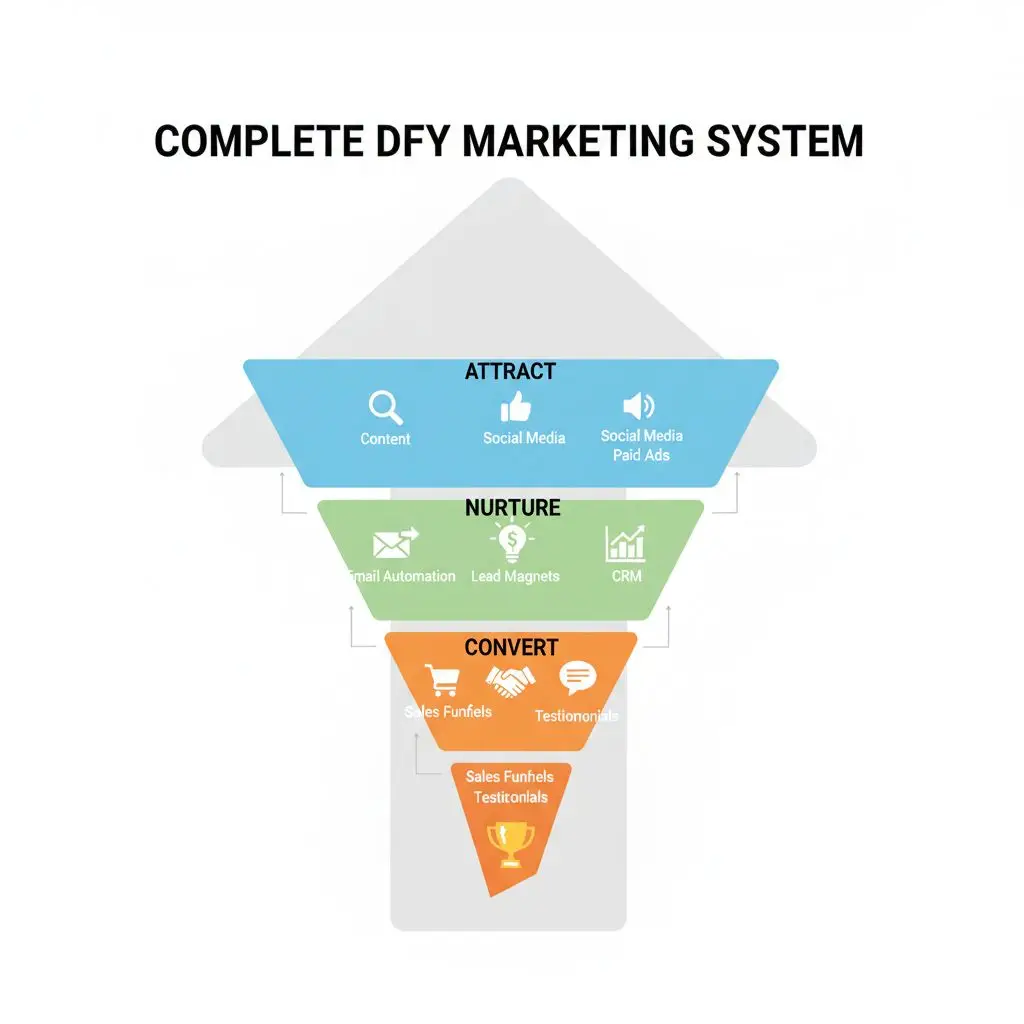
That’s the gap a DFY marketing system is built to close. Instead of three separate jobs managed across three separate platforms, a properly built system runs attract, nurture, and convert as one continuous, automated process. The difference between having the tools and having a system is exactly that: continuity. Teams at Business Loud have observed that this fragmentation – not budget – is the most common reason small businesses stall on marketing ROI.
What Attract, Nurture & Convert Actually Does
These three words get used loosely in marketing circles, so it’s worth being specific about what each stage does inside a properly built system.
Attract: Qualified Traffic, Not Just Clicks
Attract is everything that puts a business in front of the right people – search visibility through SEO and AI-driven answer engine optimization, local listings, content built around the questions customers are already asking, and paid channels where appropriate. The goal isn’t raw traffic volume. A true DFY system uses a clear Ideal Client Profile (ICP) and real campaign data to guide targeting decisions, producing qualified traffic that already matches what the business sells.
Nurture: Automated Follow-Up That Feels Personal
Most leads won’t buy on day one. Nurture is the automated sequence of emails, texts, and follow-ups that keeps those prospects warm instead of letting them go cold. A well-built nurture sequence adjusts based on behavior – someone who requested a quote gets a different follow-up path than someone who downloaded a checklist. When done right, it reads like one-to-one communication, even though it’s powered by templates, workflows, and intelligent triggers behind the scenes.
The data backs this up: personalized email campaigns can increase click-through rates by 14-41% compared to generic sends. And companies that excel at lead nurturing generate 50% more sales-ready leads at 33% lower cost – a significant edge over businesses relying on manual follow-up.
Convert: From Warm Lead to Booked Customer
This is where the system turns interest into revenue. Conversion infrastructure typically includes one-click calendar booking embedded into emails and landing pages, automated no-show and reschedule sequences, review and referral requests after job completion, and reactivation campaigns for past customers who’ve gone quiet. The sales conversation still happens between humans – but by the time a lead reaches that point, the system has already educated, pre-qualified, and warmed them up.
Why Disconnected Tools Keep Failing You
Businesses that do invest in marketing often end up with a stack of tools that don’t communicate: an email platform disconnected from the CRM, a website that doesn’t route leads automatically, ads running with no follow-up sequence behind them. Industry data consistently shows that data fragmentation and tool overload are among the top operational pain points for small businesses, with a majority reporting that integration – not access to tools – is the core obstacle.
8-12 Hours a Week Lost to Manual Marketing
The average small business owner spends somewhere between 8 and 12 hours per week on marketing tasks – posting, writing follow-up emails, chasing reviews. That’s close to an extra full workday, every week, on top of running the actual business. A connected system reclaims that time by automating the repetitive, rule-based work that currently falls on the owner’s plate.
Integration Is the Real Barrier – Not the Tools Themselves
Industry analysis consistently identifies integration as a primary challenge for marketers – not a shortage of tools, but the inability to make existing tools work together effectively. This is the core problem a complete DFY system is specifically designed to solve. The tools already exist. Wiring them into something that actually runs itself is the harder part, and it’s what separates a system from a software subscription.
What a Complete DFY System Replaces
A side-by-side comparison makes the trade-off concrete:
DIY / Piecemeal Tools Complete DFY System Weeks to months of self-managed setup Days, built and configured for you 8-12+ hours/week of owner time Minimal – review and approve Manual or inconsistent lead follow-up Automated, every lead, every time Owner responsible for tool integration Pre-integrated by design Owner researches and decides strategy Mapped out for the business in advance
Pre-Integrated by Design, Not by Duct Tape
Building an equivalent system in-house – a marketing hire or two, plus a stack of separate subscriptions – commonly runs into tens of thousands of dollars per year before results start compounding. A pre-built DFY system covering the same ground is typically a fraction of that cost, because the strategy, templates, and integrations have already been developed once and are being deployed rather than built from scratch. Research shows that marketing automation delivers strong returns – with some studies reporting businesses earning over $5 for every $1 spent – reflecting the efficiency gains of running campaigns through a unified system versus scattered channels.
How AI Makes the System Smarter Over Time
Modern DFY platforms have moved well beyond simple email autoresponders. AI now plays an active role in analyzing marketing gaps, proposing campaigns to close them, personalizing copy and timing for different audience segments, and scoring leads in real time so the warmest prospects rise to the top of the pipeline automatically.
This isn’t a set-it-and-forget-it layer. AI-powered systems improve as they collect more data – refining which messages convert, which channels produce the best leads, and which follow-up timing drives the most bookings. Research on AI-driven marketing shows that businesses running connected, AI-enhanced campaigns see roughly 20-30% better returns, more conversions, and lower acquisition costs than those running channels in isolation. Businesses that shift from fragmented approaches to a unified attract-nurture-convert strategy consistently report meaningful lifts in conversion rates across the board.
What You Still Need to Bring
“Done-for-you” doesn’t mean “done without you.” A DFY system handles the operational heavy lifting, but two inputs from the business owner remain non-negotiable.
Strategic Direction & Offer Clarity
The system needs to know who it’s targeting, what outcomes the business promises, and what a successful client looks like. Without clear offer positioning – pricing, guarantees, and constraints – even the best automation will produce mismatched leads. Think of it like hiring a world-class operations team: they still need a vision and decisions to execute against.
Sales Ownership at the Right Moment
The system can educate, pre-qualify, and warm a lead. But someone still needs to show up for the actual sales conversation, run the call, and close the deal. The role shift for the owner is meaningful – from chief firefighter to chief decision-maker – but sales ownership doesn’t disappear. By the time a lead arrives at that conversation, most of the groundwork is already done, making it the most high-value use of the owner’s time.
How to Spot a Genuinely Complete System
Not all “done-for-you” offers are actually complete. Many cover only the attract stage – ads or SEO – and treat nurture and convert as afterthoughts. A few questions separate a real system from a repackaged single tool:
- Does it include a specific plan for your business? A real system maps to your actual services, market, and goals – not a generic template applied to every client.
- What happens after someone becomes a lead? If the answer stops at “you’ll get notified,” the nurture and convert stages aren’t built out.
- Is follow-up automatic, or does it depend on someone remembering? The entire value of a system is that it doesn’t rely on a busy owner’s memory.
- Can you see what’s working? Clear reporting on lead sources, pipeline stages, and revenue attribution is non-negotiable. If a system can’t show which leads converted and why, it can’t be optimized.
- Is there a real person available to tune the strategy? The best DFY systems combine automation with a human layer that adjusts based on real results – not a black box that runs without oversight.
Businesses Running All Three Stages Together Win – The Data Is Clear
Integrated marketing strategies – ones that connect attract, nurture, and convert into a single continuous process – consistently outperform fragmented approaches across every major metric: lead volume, conversion rate, and acquisition cost. Industry analysis confirms that this kind of unified approach drives consistent business growth and customer loyalty, not just a short-term traffic bump.
The businesses seeing the strongest results aren’t necessarily spending the most. They’re the ones who stopped patching together disconnected tools and plugged into a system built to run the whole process end to end. If the current setup depends on the owner personally remembering to follow up, post, or check in on leads, that’s the clearest signal that a complete DFY system – rather than one more standalone tool – is the most practical next step.
To find out what a fully integrated marketing system looks like in practice, Business Loud specializes in building and running complete attract-nurture-convert systems for small businesses ready to stop managing disconnected tools and start seeing compounding results.
Related posts:
 Why Isn’t My Business Showing Up on Google Maps? 7 Reasons You’re Invisible to Local Customers
 How to Attract High-Value LinkedIn Clients Without Sounding Salesy
 What Should Website Changes Do? Outcome-Based Promises Replace Service Lists
 How to Differentiate: Proprietary Method Creation & Competitive Moats
 Top 10 Methods to Get Qualified Leads: SEO, Email ROI & Referral Trust
 Top 50 Home Service Trades Paid Lead Costs and Average Project Income
 What’s the Easiest Way to Engage Website Visitors & Capture Leads?
 Get Your Business Cited in AI Search Results (And Watch Traffic Follow)
 How to Choose a Personal Injury Lawyer Online: Reviews, Experience, and Factors
 Call Tracking: Turning Marketing Spend into Predictable Revenue